Two MSP quotes for the same headcount can be far apart. Here is how we read them from Winnipeg — licences vs labour, what belongs in an SLA, and when a hire still wins.
In short. We do not publish a per-seat SKU you would have to honour. Two Canadian MSP PDFs for the same headcount can be far apart because the cheap one usually left tools or after-hours off the page. Line up inclusions, keep Microsoft licences on a separate line, then talk.
We get the same email about twice a week. Someone in the GTA, Winnipeg, or Montreal forwards two PDFs. Same seat count. One monthly number looks like a bargain. The other looks like a luxury tax. They want us to pick a winner in a sentence.
We will not. The cheap one has usually left security tools, after-hours, or onboarding off the page. The expensive one has sometimes padded vCIO theatre you do not need. The only fair comparison is labour plus tools plus what happens on a Sunday when email is dead.
Amen Security is a Winnipeg MSP. We sell managed IT on a written per-seat SLA after a free assessment — remote across Canada and the US, French when the tickets are in French. We also build sites and internal apps when that is the actual bottleneck. We do not publish a fake SKU here. If a vendor already printed one, treat it as marketing until the inclusions match.
A lot of “IT got more expensive in 2026” talk is really the Microsoft 365 commercial list. On 1 July 2026 Microsoft raised several business suites for new and renewing customers. Business Premium did not jump with the others; Basic and Standard did. Existing tenants usually keep the old rate until the next renewal, then the new list hits.
That invoice is licences. An MSP invoice is people, monitoring, backups, and whoever answers at 21:00. Mix them up and you will shave a little off Microsoft while the help desk is still a guy who only works Tuesdays. We keep licence lines visible so you can see which number moved.
Canadian per-seat deals for a normal office (laptops, Microsoft 365, a couple of line-of-business apps) still come in a wide band. Monitor-and-ticket shops sit at the bottom. Full help desk plus patching plus backup watch plus identity hygiene sits in the middle. Add EDR, tested restores, and someone who will fight your insurer’s questionnaire, and the number climbs. Hourly break-fix still exists; it looks cheap until the first ugly weekend. We wrote that fight out in MSP vs break-fix.
A junior hire with benefits, tools, and no coverage when they are off work is often more than a core MSP for a 20–40 person firm — and they still cannot be your web developer, your Azure person, and your 2 a.m. restore. Past roughly eighty seats, a hybrid (someone internal who owns the business, MSP for depth) is the usual adult setup. Under fifteen very simple seats, a sharp contractor can still win. There is no moral victory in outsourcing a printer.
If you want geography in writing: Winnipeg, Toronto, Montreal. Same remote model. No pretend storefront.
We ask five things. If the PDF cannot answer them, the monthly number is decoration.
Cyber insurers in 2026 are rude about MFA, endpoint detection, and backups you have actually restored. The Canadian Centre for Cyber Security still treats ransomware as the main cybercrime problem for Canadian organizations. That is why “antivirus included” on a cheap quote is not the same product as a stack an underwriter will accept. We are not reciting their whole assessment here. Read theirs. Then ask your MSP who fills the insurance form.
Professional services, Manitoba or the GTA, Microsoft 365, two apps they cannot miss a day. No full-time IT. Break-fix will look cheapest until a tenant lockout. One hire covers days and vanishes on vacation. A core MSP is the option where someone already knows the tenant when payroll is due. If they also need a client portal, that is a scoped build, not a buried line in the seat price. We will say no if the portal is the real job and they only wanted a cheap help desk.
Free assessment — written per-seat scope, no theatre
Can you just email a price? No. We would be guessing your backup, your M365 mess, and whether you have a server nobody admits to. The assessment is the product until the one-pager exists.
Is per-seat always cheaper than hiring? No. Tiny teams with a capable owner-operator often should not retain us for printers. Twenty-plus seats with Microsoft 365 and anyone asking about insurance is where the SLA usually wins on coverage, not on pride.
Do seats include a new website? No honest shop does that. We split opex and project work. Same humans. See development.
Winnipeg serving Dallas? If monitoring and identity are built for remote, yes. You are buying engineers and response times.
What happens after we talk? A working session, a scope you can put next to the other two PDFs, per-seat numbers with inclusions. You can walk. Start on the consult tab.
Do not pick the low PDF. Line up inclusions. Add Microsoft’s licence line so you know what jumped in July. If you want us in that pile, say so. Request the assessment
Your comment will be published after our team reviews it.
Keep reading
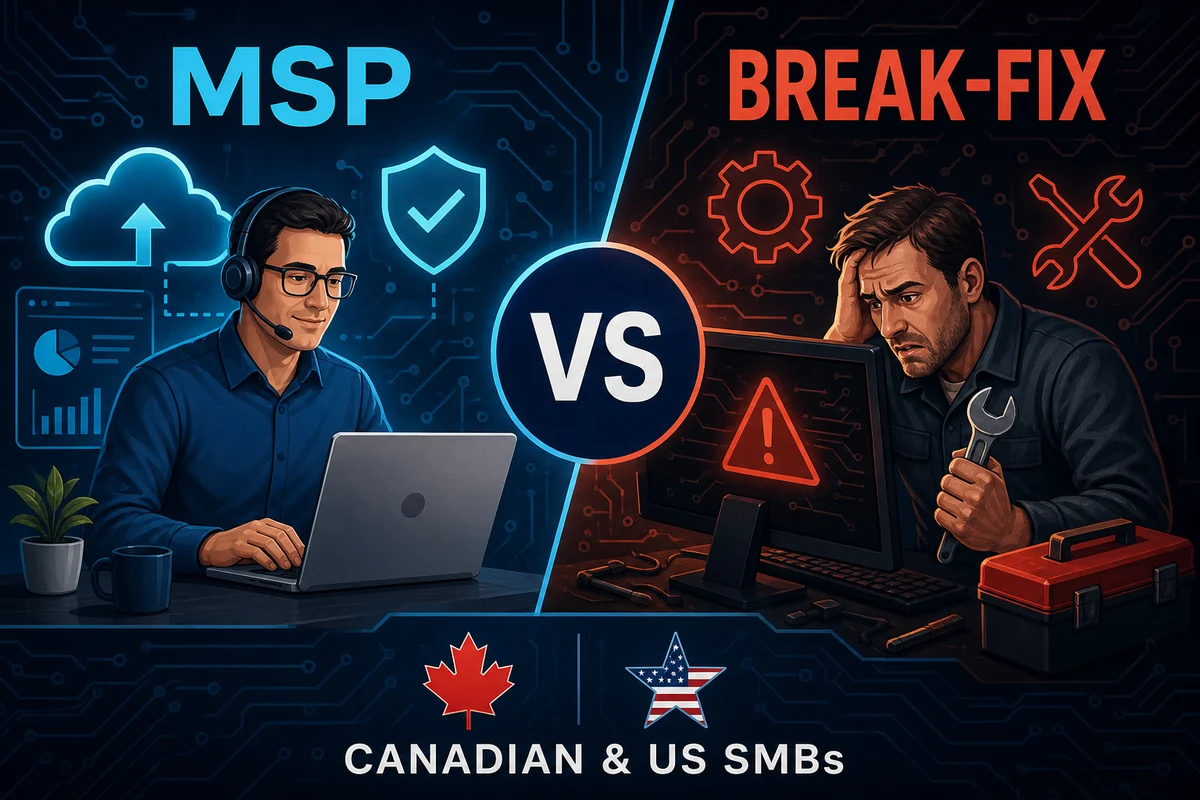
Reactive IT support looks cheaper until downtime, ransomware, and staff burnout show the real bill. Here is how managed services compare for Canadian small and mid-sized businesses.
A practical order of operations for moving workloads to Microsoft 365 and Azure: inventory, identity, networking, data residency, and rollback — without the weekend surprise.
Consent, access requests, breach notification, and vendor contracts — explained for IT teams who process personal information on behalf of Canadian businesses.