Reactive IT support looks cheaper until downtime, ransomware, and staff burnout show the real bill. Here is how managed services compare for Canadian small and mid-sized businesses.
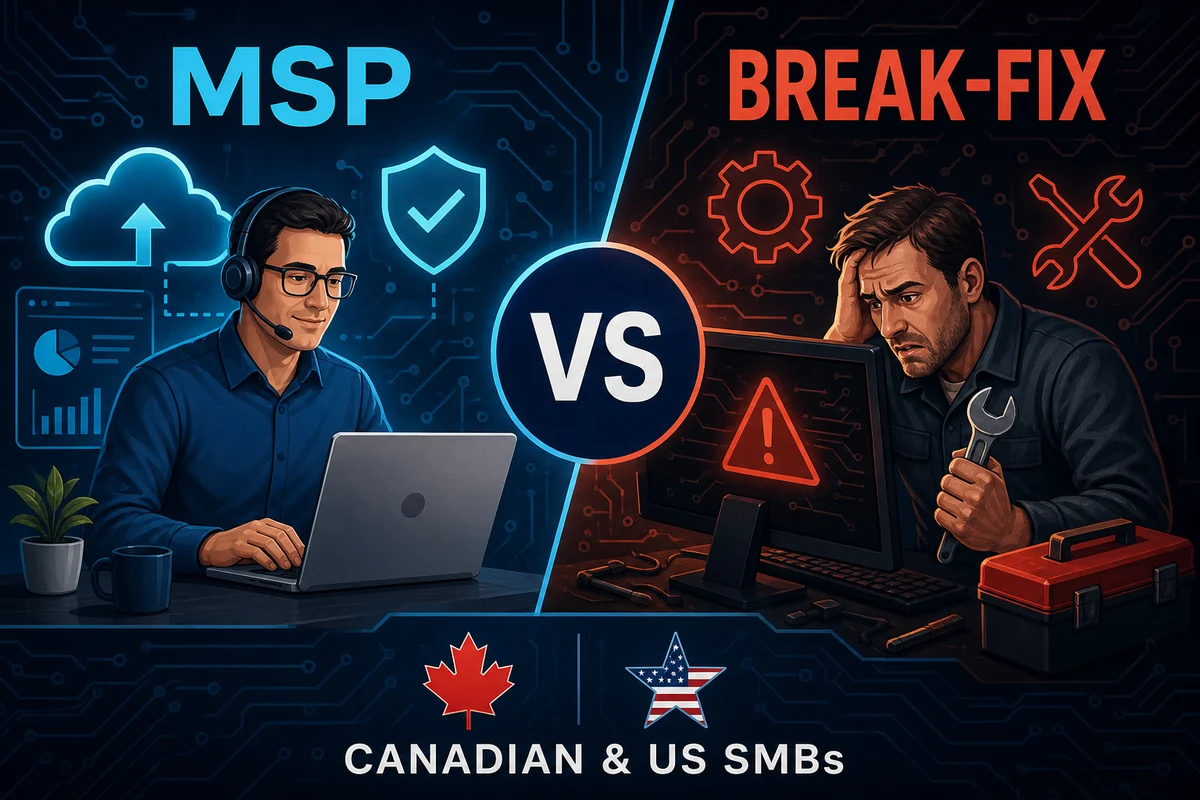
If you run a Canadian business with 10–200 employees, you have probably heard two pitches: managed IT services (MSP) with a flat monthly fee, and break-fix where you only pay when something breaks. On paper, break-fix wins. In practice, the math rarely holds once you factor in downtime, security incidents, and the hidden cost of context switching.
Break-fix vendors bill by the hour or by the ticket. That sounds fair — until a ransomware event, a failed migration, or a Friday-afternoon outage turns into emergency rates and lost revenue. Canadian insurers and regulators increasingly expect documented patching, backups, and access controls. A pure break-fix relationship rarely includes proactive monitoring, patch management, or quarterly business reviews.
A managed service provider operates your environment under a defined SLA: helpdesk, endpoint management, backup verification, vulnerability patching, and escalation to senior engineers when needed. You trade variable emergency invoices for a predictable operating budget — and you gain a team that already knows your network, your identities, and your critical apps.
Typical MSP scope for SMBs includes:
Break-fix is not evil. It fits very small teams with simple stacks, internal IT staff who only need overflow help, or one-time projects with a fixed scope. It becomes risky when IT is business-critical but nobody owns hygiene between incidents.
For most Canadian SMBs in 2026, managed services reduce risk and stabilize IT spend compared to reactive break-fix. The right MSP should feel like an extension of your team — with clear SLAs, bilingual support if you need it, and security baked in from day one.
Book a free IT assessment with Amen Security to map your current support model against your growth plans.
Your comment will be published after our team reviews it.
Keep reading
Two MSP quotes for the same headcount can be far apart. Here is how we read them from Winnipeg — licences vs labour, what belongs in an SLA, and when a hire still wins.
A practical order of operations for moving workloads to Microsoft 365 and Azure: inventory, identity, networking, data residency, and rollback — without the weekend surprise.
Consent, access requests, breach notification, and vendor contracts — explained for IT teams who process personal information on behalf of Canadian businesses.